A Personalized Learning Platform for Auto-Electrician Vocational Learners
A web platform that tutors auto-electrician trainees in English, Urdu and Roman Urdu. A LangGraph reasoning agent generates lessons, quizzes and diagnostic guidance matched to the learner’s level, grounded in curated curriculum material and remembered across sessions.
Status
In progress
School
SEECS, NUST
Baseline curriculum
TEVTA / NAVTTC
Languages
English, Urdu, Roman Urdu
01Team
MA
Muhammad Abdullah Waqar
Student · CMS 458785
SM
Syed Mohammad Abdullah Rashid
Student · CMS 467072
UK
Uswa Khan
Student · CMS 454092
Dr. Junaid Younas
Supervisor
Dr. Muhammad Moazam Fraz
Co-Advisor
02Abstract
This project proposes a web-based personalized learning platform for auto-electrician vocational learners in Pakistan, supporting English, Urdu and Roman Urdu. A LangGraph-based pedagogical reasoning agent generates lessons, explanations, learning plans, quizzes and diagnostic guidance matched to the learner’s level.
Retrieval-augmented generation grounds responses in curated auto-electrician material, a learner-memory component preserves progress, strengths and weaknesses across sessions, and a recommendation agent suggests books, articles and videos. The platform supplements, and does not replace, instructors and workshop training.
~3,900
BTEC/NAVTTC curriculum chunks in the pipeline
3
languages: English, Urdu, Roman Urdu
Gemma 4 E4B
backbone chosen after two benchmarks
85
tests passed: 70 regression, 15 experiment
500
messages handled in a single session
22,656
characters handled in one input without failure
03Motivation and problem
Modern vehicles rely on ECUs, sensors and diagnostic codes, making auto-electrician training increasingly demanding, while most technical material is in English and expert guidance outside class is scarce.
Problem. Vocational instruction — the TEVTA/NAVTTC curriculum is the project’s baseline — uses the same content, pace and difficulty for every learner. General-purpose chatbots lack learner memory and domain grounding, and learning resources are fragmented across tools. Roman Urdu, with no standard spelling, adds further difficulty. Learners need an adaptive, multilingual, domain-grounded platform that remembers them and delivers the right content at the right time.
04Methodology
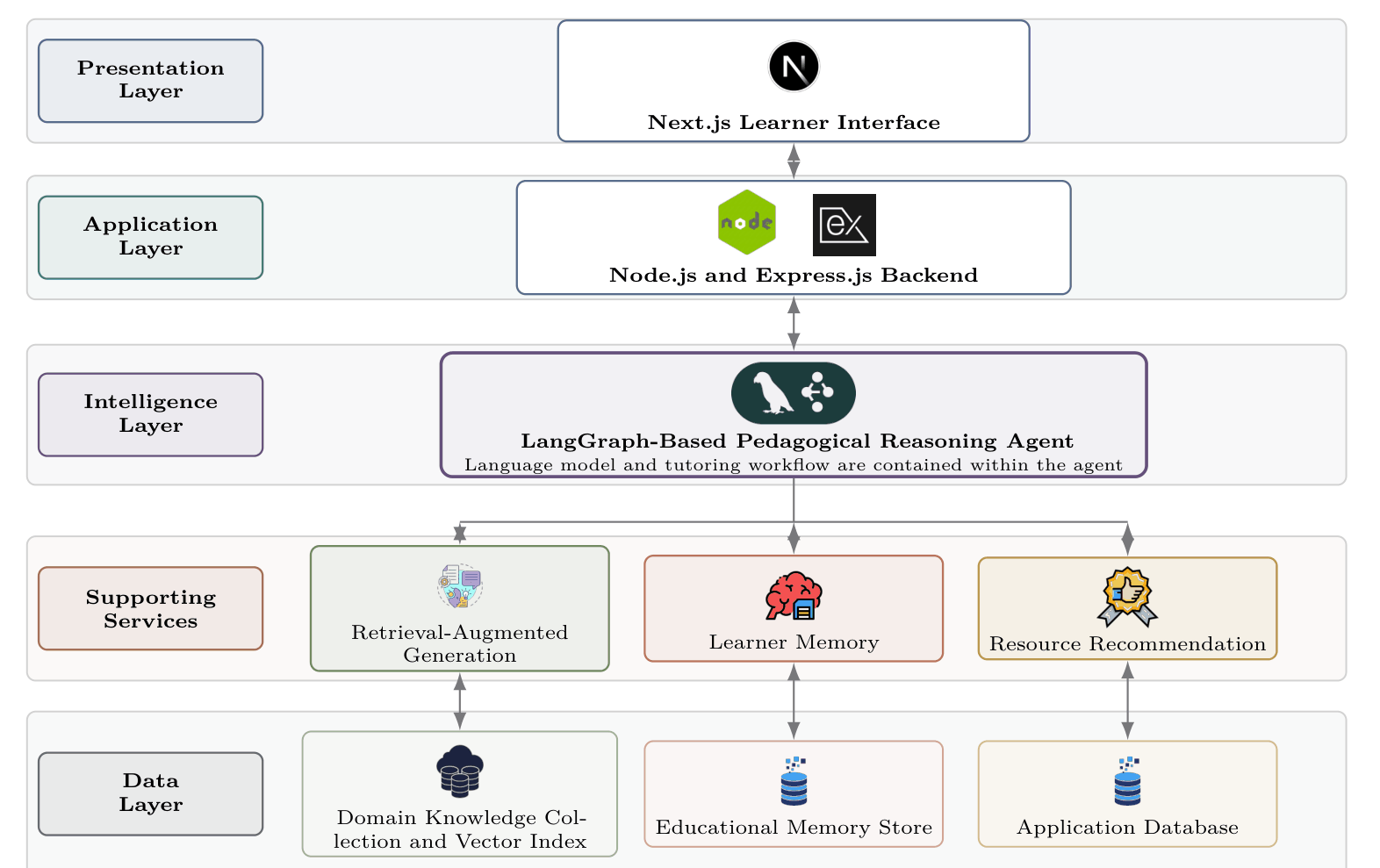
The system is a modular, layered web application built in Agile sprints with Next.js, Node.js/Express.js and LangGraph; the vector database and language model are to be selected by comparative evaluation.
1. Context. Receive learner context and language.
2. Intent. Classify the tutoring intent.
3. Retrieval. Retrieve domain passages and, when needed, learner memory.
4. Generation. Generate a grounded, skill-adapted response — Roman Urdu keeps English technical terms.
5. Recommendation. Invoke the recommendation agent.
6. Memory. Update learner memory.
Layered system architecture with the reasoning agent as central orchestrator.
05Preliminary results
Backbone selection
Two backbone benchmarks showed Gemma 4 E4B was the strongest overall, so Gemma was chosen as the local tutor model.
Learner memory
The learner memory module, built on LangMem with PostgreSQL/pgvector, passed 70 regression tests plus 15 experiment tests, and handled a 500-message session and a 22,656-character input without failure.
Curriculum pipeline
The tutor pipeline runs on about 3,900 BTEC/NAVTTC curriculum chunks in English, Urdu and Roman Urdu, with 20% of chunking done so far.
Resource agent
The resource agent returns results using Tavily.
06Expected outcomes
Deliverable. A functional web-based tutoring platform with personalized lessons, quizzes, learning plans, question answering and resource recommendations in English, Urdu and Roman Urdu.
Contributions. An integrated architecture combining learner memory, retrieval-augmented generation, multilingual delivery and recommendation, plus a case study of AI tutoring in a focused vocational domain.
Impact. Widening access to personalized technical learning.
07Sustainable Development Goals
4Quality Education
8Decent Work and Economic Growth
10Reduced Inequalities
08Publications
Two papers on the project’s backbone-model evaluation have been produced.
“Architecture Is Not the Whole Story: Evaluating Transformer, Hybrid, and Recurrent Backbones for Agentic Tutoring.” Accepted at FIT 2026; camera-ready in preparation.
“A Holistic Benchmark of Language Models for Educational Agents.” Under review at the IAAI conference.