Multimodal Deep Learning for Hyperspectral Forest Health Monitoring at BIFoR FACE
A remote-sensing and analysis framework for 25-band fixed-camera imagery of the BIFoR Free Air CO2 Enrichment experiment, ending in CanopyPulse — a web system that shows how the optical signal of a mature oak forest changes under elevated CO2.
Status
Proposal stage, in progress
Lab
MachVIS, SEECS, NUST
Field site
BIFoR FACE, Staffordshire, UK
Imagery
January – June 2026
01Team
MH
Mohammad Hasnain
Student · CMS 462247
MA
Mohid Arshad
Student · CMS 455977
TM
Tahir Mehmood
Student · CMS 458593
Dr. Zuhair Zafar
Advisor
Dr. Muhammad Moazam Fraz
Co-Advisor
02Abstract
Scientists need to know how a mature forest behaves when the air contains more CO2 than today. The Birmingham Institute of Forest Research (BIFoR) runs a Free Air CO2 Enrichment (FACE) experiment in which three forest patches receive about 150 ppm extra CO2 and three matching patches receive ordinary air as controls.
This project proposes a remote sensing and data analysis framework for fixed-camera images covering 25 spectral bands between 665 and 975 nm. It covers data quality checks and calibration, mapping of image regions to experimental patches, calculation of the vegetation indices the sensor can actually support, treatment-versus-control statistics that respect the real experimental design, and simple machine learning models where enough ground truth exists. The final product is a web-based analysis system, CanopyPulse. It does not measure CO2 directly; it shows how the optical signal of vegetation changes.
~120 GB
fixed-camera imagery, Jan–Jun 2026
25
spectral bands, 665–975 nm
9
patches: 3 treatment, 3 control, 3 untouched
+150 ppm
CO2 over ambient in treatment patches
35
candidate vegetation indices catalogued
~175 yr
oak woodland, enriched since April 2017
03Motivation and problem
Introduction. BIFoR FACE sits in a mature broadleaf woodland in Staffordshire, UK, dominated by roughly 175–180-year-old oak and under CO2 treatment since April 2017. It has nine patches of about 30 m diameter: three treatment, three ambient-air infrastructure controls and three untouched.
Motivation. Leaf-by-leaf measurement is accurate but slow, while a fixed camera views the same place repeatedly, so it can follow seasonal change and scale up field physiology. Satellites do not fit well, because the patches are only about 30 m wide and the same view of the same arrays is needed over and over.
Problem. The image data cannot be used properly by viewing pictures one by one. The team needs a single repeatable workflow to calibrate raw values, locate the arrays, calculate valid indices, compare treatment and control fairly, and check results against biological data. These steps are not yet joined together. The signal may be small and index-specific — an earlier leaf-level study found that overall reflectance did not change much while one pigment-related index did — so careful, validated analysis is needed rather than a quick classifier.
04Methodology
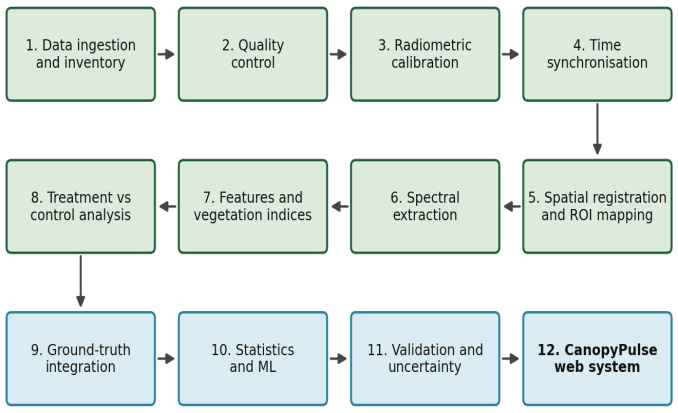
Data. About 120 GB of images from two fixed cameras with 25 spectral bands (about 665–975 nm); raw data kept untouched.
Calibration and QC. Convert raw sensor counts to reflectance using the Empirical Line Method where reference targets exist, and flag data whose calibration cannot be shown to be good.
Alignment. Register images and map regions of interest to the experimental arrays and dates.
Features. Spectral statistics and a sensor-compatible subset of a 35-index candidate catalogue (NDVI, NDRE, CIre, NIRv and others).
Analysis. Treatment versus control compared at array level with mixed-effects or repeated-measures models, effect sizes and confidence intervals, to avoid pseudo-replication.
ML and validation. Simple, explainable baselines first and only where enough ground truth exists, with leakage-safe validation grouped by image and region, time-blocked and leave-one-array-out.
Output. The CanopyPulse web system — a Python pipeline, FastAPI backend, React front end and PostgreSQL/PostGIS store.
The end-to-end methodology: twelve stages from raw ingestion to the CanopyPulse web system.
05Preliminary results
This is a proposal-stage project, so no experimental results are reported yet. Progress so far:
Dataset obtained
The 2026 dataset has been acquired — about 120 GB from two cameras across 25 bands — and initially inspected.
Calibration risk identified
The supplied TIFF files appear to hold raw 16-bit counts, and the inspected files contained no calibration or exposure information, so calibration is treated as a key dependency.
Index catalogue prepared
A catalogue of 35 candidate vegetation indices adapted to the 665–975 nm band centres has been prepared.
Unsupported indices excluded
Indices the sensor cannot support — PRI, PSRI, GNDVI, EVI, NDWI and SIF — have been identified and excluded.
06Expected outcomes
A cleaned, documented inventory of the 2026 dataset; a repeatable calibration and QC workflow, dependent on calibration references; image regions mapped to the experimental units; a validated set of vegetation indices for the 665–975 nm sensor; time plots of spectral change and treatment/control differences where detectable; measured links between selected features and available ground truth; a leakage-aware baseline model where enough labels exist; and a working CanopyPulse prototype with a clear list of limitations.
The main contribution is a repeatable processing pipeline and a usable tool for the BIFoR team.
07Sustainable Development Goals
13Climate Action
15Life on Land
9Industry, Innovation and Infrastructure
17Partnerships for the Goals
08Related publications
Key BIFoR publications that this project builds on. These are prior work by the BIFoR FACE community, not outputs of this project.
Hart, K. M., et al. (2020). Characteristics of free air carbon dioxide enrichment of a northern temperate mature forest. Global Change Biology, 26(3), 1023–1037. doi.org/10.1111/gcb.14786
MacKenzie, A. R., et al. (2021). BIFoR FACE: Water–soil–vegetation–atmosphere data from a temperate deciduous forest catchment, including under elevated CO2. Hydrological Processes, 35(3), e14096. doi.org/10.1002/hyp.14096
Gardner, A., et al. (2021). Is photosynthetic enhancement sustained through three years of elevated CO2 exposure in 175-year-old Quercus robur? Tree Physiology. doi.org/10.1093/treephys/tpab090
Gardner, A., et al. (2022). Are chlorophyll concentrations and nitrogen across the vertical canopy profile affected by elevated CO2 in mature Quercus trees? Trees. doi.org/10.1007/s00468-022-02328-7
Jones, A. L., et al. (2025). The effect of elevated CO2 on hyperspectral leaf reflectance in mature trees. Trees, 39, 69. doi.org/10.1007/s00468-025-02650-w
Kourmouli, A., et al. (2025). Rapid increase in soil respiration and reduction in soil nitrate availability following CO2 enrichment in a mature oak forest. ACS Omega. doi.org/10.1021/acsomega.4c09495
Roberts, A. J., et al. (2022). Effects of elevated atmospheric CO2 concentration on insect herbivory and nutrient fluxes in a mature temperate forest. Forests, 13(7), 998. doi.org/10.3390/f13070998