Learner: An Adaptive Learning Management System and AI-Driven Personalized Tutoring for Vocational Training
An adaptive LMS and AI tutor that builds a knowledge graph from the instructor’s own course material, tracks each trainee’s mastery across three Bloom levels, and assembles the next study session from what they are ready to learn. First pilot: auto-electrician training.
Status
In progress
Programme
BS Data Science
School
SEECS, NUST
Pilot domain
Auto-electrician training
01Team
MH
Muhammad Hanzala Bin Rehan
Student · CMS 461738
MA
Muhammad Abdullah Janjua
Student · CMS 459244
Dr. Junaid Younas
Advisor
Dr. Muhammad Moazam Fraz
Co-Advisor
02Abstract
Learner is an adaptive learning management system and AI tutor for Pakistan’s vocational trainees. It automatically builds a knowledge graph of topics, subtopics and prerequisites from an instructor’s own course material, tracks each trainee’s mastery of every subtopic across three Bloom’s-taxonomy levels, and uses a Zone of Proximal Development engine to decide what each trainee should study next.
Short study sessions are assembled from existing material or produced by specialised AI agents — text, audio, visual, quiz and Socratic dialogue — checked by a quality gate and cached for reuse across the cohort. The first pilot targets auto-electrician training.
3,500+
TVET institutes in Pakistan
450+
trades taught
500,000+
trainees a year
28–29%
TEVTA graduates in work (World Bank, 2019)
~2σ
gain from one-to-one mastery tutoring (Bloom, 1984)
7
modules forming one closed adaptive loop
03Motivation and problem
Pakistan’s TVET system, led by NAVTTC and the provincial TEVTAs, runs more than 3,500 institutes teaching over 450 trades to more than 500,000 trainees a year — yet trainees are taught in bulk. Instructors cannot track what each learner has mastered, curricula are often outdated, and tracer studies found only 28–29% of TEVTA graduates in work (World Bank, 2019).
One-to-one, mastery-based tutoring lifts achievement by about two standard deviations (Bloom, 1984), but human tutors cannot scale. Existing platforms solve only parts of the problem: learning management systems such as Moodle and Canvas manage courses but model no knowledge; adaptive tools such as ALEKS and Knewton Alta depend on fixed publisher content; and AI study tools generate content without a persistent learner model.
Problem statement. Pakistan’s vocational trainees lack scalable, personalized, curriculum-aligned instruction. No platform builds a structured knowledge model from an instructor’s own material and uses it to personalize both what each trainee studies and how deeply.
04Methodology
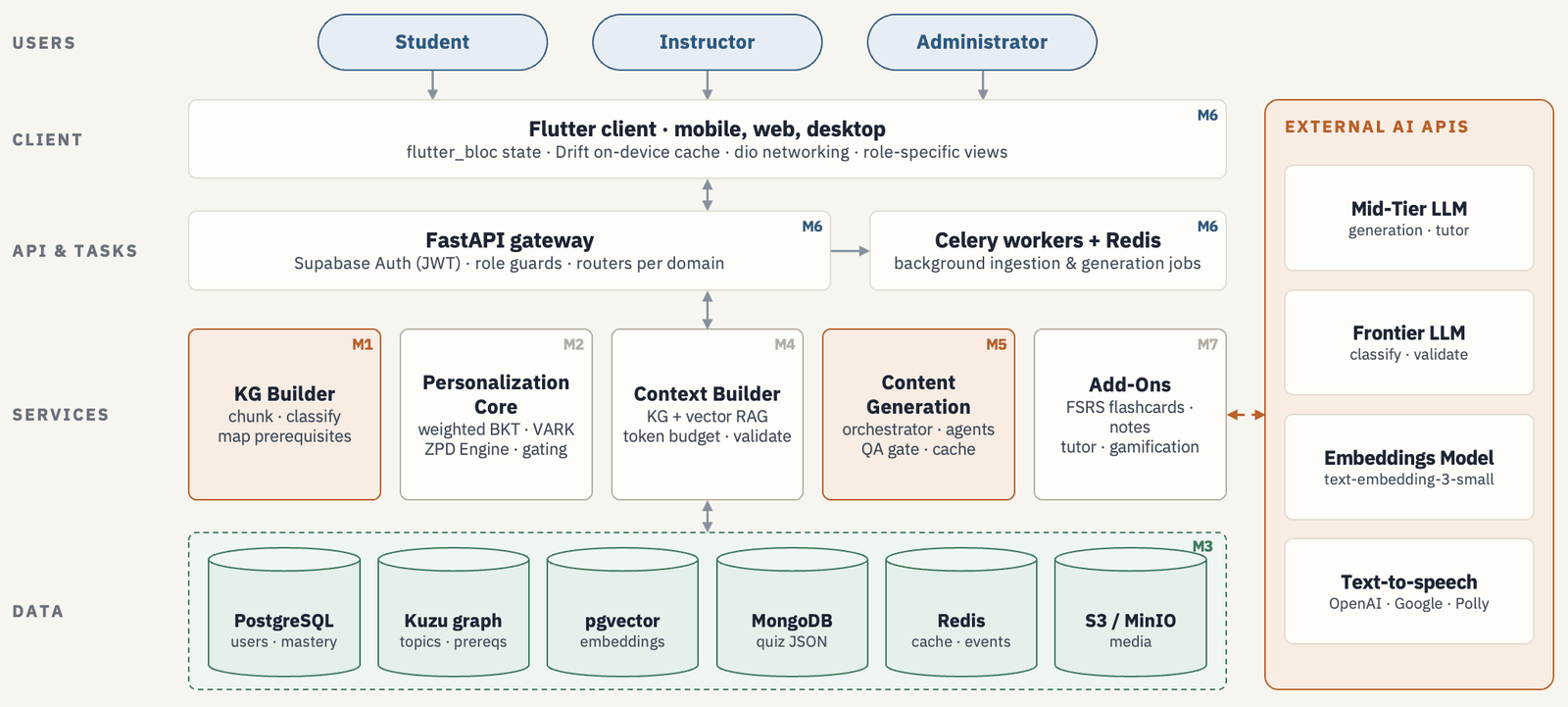
1. Knowledge Graph Builder. Chunks slides, documents and lecture video; a language model labels each chunk with topic, subtopic and Bloom ceiling and proposes prerequisite links, sending uncertain items to the instructor for review.
2. Personalization Core. A time- and attempt-weighted Bayesian Knowledge Tracing model updates mastery per Bloom level, and a ZPD engine picks the next target within the instructor’s learning outcomes.
3. Data Layer. PostgreSQL, Kuzu graph database, pgvector, MongoDB and Redis.
4. Context Builder. Graph-plus-vector retrieval within a token budget.
5. Adaptive Content Generation. An orchestrator plans roughly 30-minute sessions, reusing cached material or calling content agents behind a QA gate.
6. Application. A Flutter client with a FastAPI/Celery backend and student, instructor and admin roles.
7. Add-ons. FSRS spaced-repetition flashcards, notes and gamification.
Learner system architecture: seven modules forming one adaptive loop.
05Preliminary results
Data layer implemented
PostgreSQL 16 on Supabase with async SQLAlchemy, PgBouncer and Alembic; Kuzu graph store and vector store behind stable repository interfaces, with optimistic locking for concurrent mastery updates.
Personalization core implemented
A ZPD Engine over prerequisite links; a Quiz Mapping Agent using FastMCP with schema-enforced output and automatic repair; and a Personalization Update Engine using hybrid BKT with multi-attempt replay, response-time weighting and reliable asynchronous updates.
Designed and in progress
The knowledge-graph schema and ingestion pipeline, Flutter-side mastery gating, and podcast and visual/animation agents on a Manim-based pipeline. The learning-science review and pilot study design are documented.
06Expected outcomes
A working adaptive LMS piloted on an auto-electrician course, running the full loop from instructor upload to personalized study session.
Measured against pre-set targets: at least 80% knowledge-graph classification accuracy; weighted BKT matching or beating standard BKT with a smaller fairness gap; at least 90% of generated items passing QA; and a learning gain over a non-adaptive control group.
Contributions. Automatic knowledge-graph construction from instructor material, Bloom-level mastery modelling, and cost-viable AI content through cohort-level caching — a practical route to digitising TVET instruction.