
AI in remote (5)

Enabling Sustainable Solutions for Agriculture and Water Resources

A 3-day training workshop on

Enabling Sustainable Solutions for Agriculture and Water Resources
Agriculture in the SAR (South Asian Region) is caught in a low equilibrium trap with low productivity of staples, supply shortfalls, high prices, low returns to farmers and area diversification – all these factors can be a threat to food security. Addressing this issue can have a great impact over the lives of the people in this region. Contributing to sustainable water and agriculture resource management systems can be a challenging task. This workshop is among many other initiatives towards a major goal of food security in the South Asian Region through stocktaking of research, potential and role of technology, and other interdisciplinary initiatives.

The intent of this workshop is three-fold. The first is exploration of activities related to research, developing technologies, and other interdisciplinary initiatives. Secondly, it shall identify gaps that can be addressed through research and development, capacity building, and knowledge management. Lastly, it shall provide a platform to the participants to establish multidisciplinary collaborations.


Objectives

  • Explore the potential of Artificial Intelligence (AI) and Internet of things (IoT) in developing sustainability in agriculture and water resources
  • Examine agriculture and food global value chain recovery challenges and the importance of enhancing interdisciplinary cooperation within the sector
  • Exchange sustainable agricultural knowledge and technological innovation
  • Share domestic and regional-level best practices for enhancing sustainable agricultural development

Output

  • Improved understanding of agriculture adaptation challenges and opportunities for building the sector’s sustainability and resilience with the use of AI and IoT
  • Constructive dialogue and network building between technology experts and agriculture practitioners
  • Presentations and other workshop materials to be uploaded on the MachVIS lab website.

Participants

  • Technology experts from TIEN member countries NRENs and Associate Organizations
  • Experts from the universities and national research organizations and the practitioners
  • Interested members of the public

Speakers

Prof. Dr. Karsten Berns

Technical University of Kaiserslautern, Germany

Dr Zahid Mehmood

Chief Scientific Officer, NARC Pakistan

Muhammad Jahanzaib

 Scientific Officer, NARC Pakistan

Dr Asad Waqar Malik

Associate Professor, SEECS, NUST, Pakistan

Dr Arsalan Ahmed

Associate Professor, SEECS, NUST, Pakistan

Dr Yasir Faheem

Associate Professor, SEECS, NUST, Pakistan

Dr Hasan Ali Khattak

Associate Professor, SEECS, NUST, Pakistan

Jakub Pawlak

Technische Universität Kaiserslautern, Germany

Qazi Hamza Jan

Technische Universität Kaiserslautern, Germany

Axel Vierling

Technical University of Kaiserslautern, Germany

Eike Gassen

Technical University of Kaiserslautern, Germany

Organizers

Muhammad Moazam fraz
Dr M. Moazam Fraz

Associate Professor,  SEECS, NUST, Pakistan

Dr. Zuhair Zafar

Assistant Professor, SEECS, NUST, Pakistan

Program Details

Partners

Machine Vision and Intelligent Systems Lab, SEECS NUST

Contact Details

Location

Email

Phone Number

AI in remote (4)

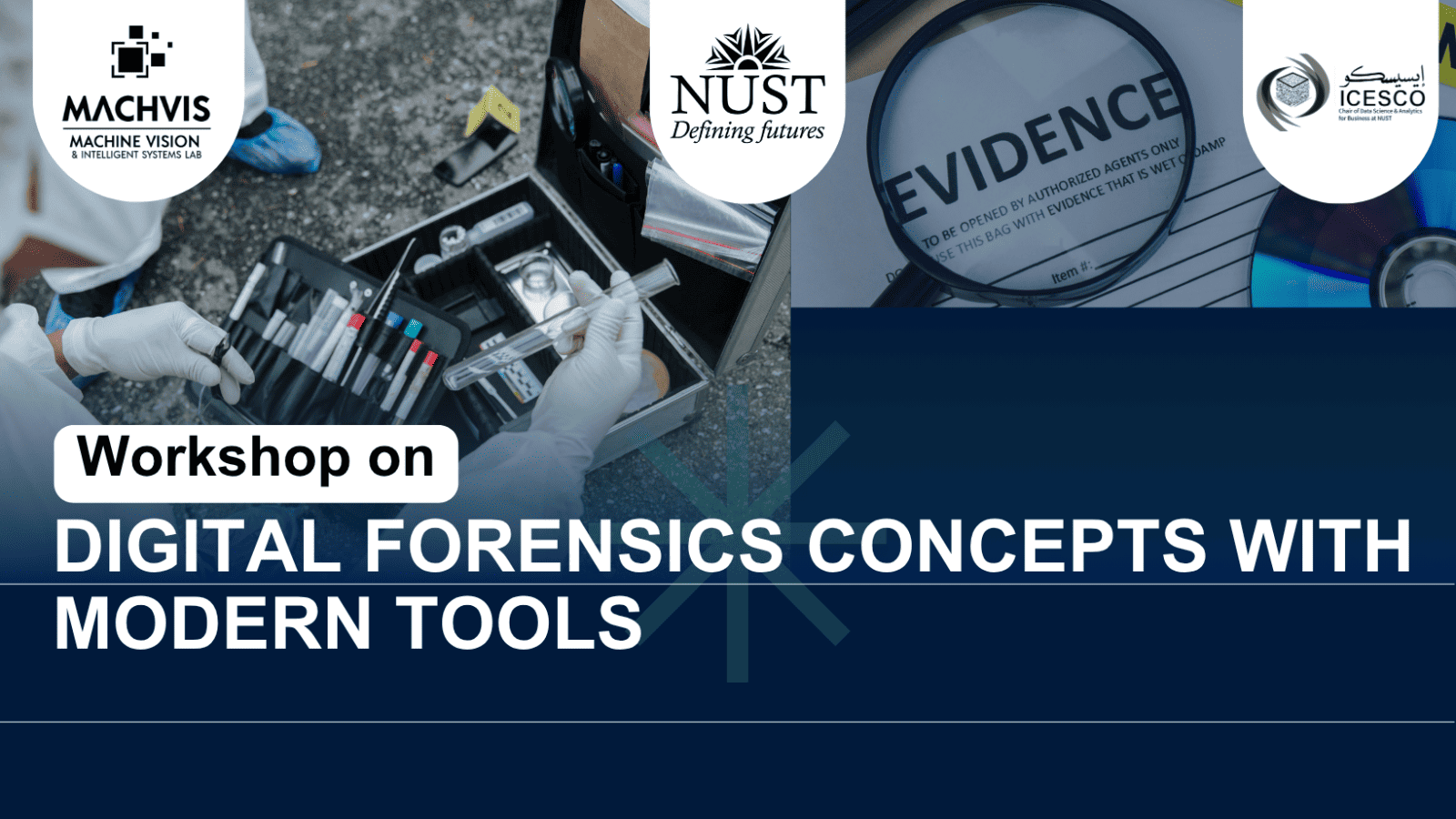
Workshop on Digital Forensics Concepts with Modern Tools

A 5-day hands-on skill enhancement boot camp on

Digital Forensics Concepts with Modern Tools

Description

The workshop will help the participants to get fundamental concepts and principles of digital forensics and its relevance to digital investigations and the examination process. It will demonstrate the recovery of digital artifacts in forensically sound manners from different OS i.e. Windows/Mobile environments. Participants will explore the forensic tools and procedures for recovering evidence from activities on the Network/Mobile. Examine and analyze the Social Media applications regarding cyber-criminal activities using modern tools. Becoming a part of this exciting workshop helps to enhance the participant's knowledge of digital forensics through enlightening lectures and training classes.

Learning Outcomes

In this workshop series, participants will learn the basics of digital forensics concerning various domains, such as Windows forensics (i.e. volatile memory, registry, and logs), Mobile Applications, and Network Investigation by employing forensics tools set through hands-on projects. Participants will
  • Understand the case studies with practical Labs of Acquisition of evidence in Windows, Android, and Network environments.
  • Learn to examine and analyze the acquired evidence and artifacts from various tools set for the court of law.
  • Learn about Multimedia files forgery detections, rebuilding the missing headers, and identifications of malicious headers.
  • Learn how to analyze Twitter, Facebook, and other social media artifacts (events, posts) to build the crime scene reconstructions.

Who Is This Training For?

  • Recent graduates looking to bolster their skillset.
  • Digital forensics investigators who aim to benefit from current market trends.
  • Cyber security and researchers who want to solve challenging digital investigation cases through modern tools.
  • Technology leaders who want to stay ahead in the competition by empowering their organizations with Digital Forensics Laboratory.
  • Undergraduate students aiming to accomplish their FYPs in the domain of Cyber Forensics.

Speakers

Dr. Mehdi Hussian
Dr. Mehdi Hussian
Assistant Professor NUST
SEECS, Pakistan
Muhammad Moazam fraz
Dr Muhammad Moazam Fraz
Associate Professor NUST
SEECS, Pakistan

Partners

Machine Vision and Intelligent Systems Lab, SEECS NUST

Program Details

Contact Details

Location

Email

34

Nazia Perwaiz has successfully defended her PhD Dissertation

Enhancing Person Re-identification by Learning Local Parts Association with Self-attention and Contextual Mapping

Abstract

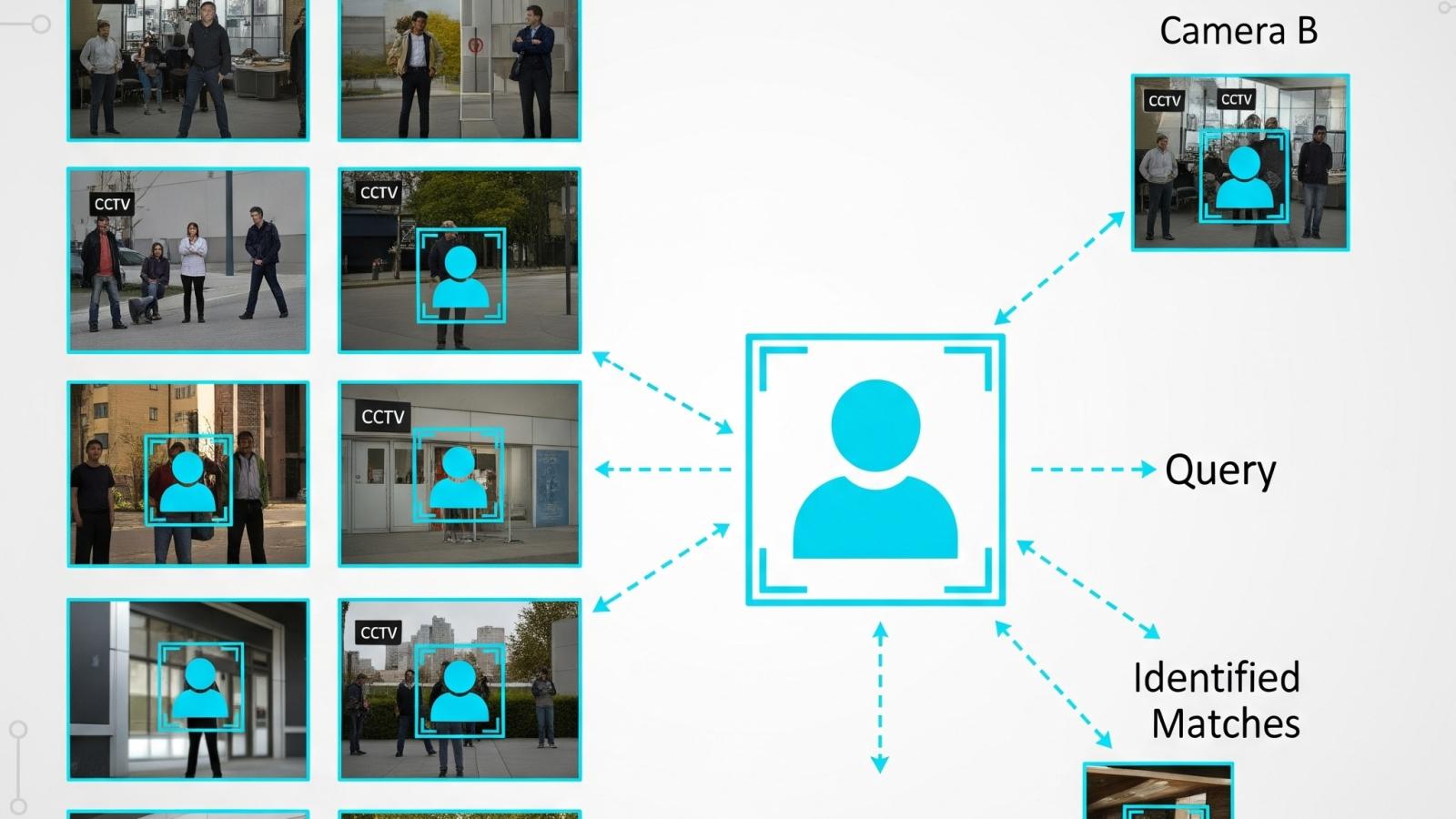
The thesis focuses on enhancing person re-identification (Re-ID) for smart visual surveillance without relying on biometric equipment, using raw images from CCTV. Traditional Re-ID solutions use convolutional neural networks (CNNs), which struggle with learning associations between distant parts of an image—a critical aspect of human vision. To address this, the thesis proposes a hybrid representation that combines handcrafted, mid-level, and deep learning features with metric learning to improve the identification process. A new network architecture, Hierarchical Refined Saliency Association Network (HRSAN), is introduced along with a complete pipeline for simultaneous detection and Re-ID (SSPDR), working on unprocessed CCTV footage.
12 11

Talk Series 2023

AI in remote (3)

Object Detection And Semantic Segmentation In Visual Data

A 5-day hands-on skill enhancement boot camp on

Deep Learning for Object Detection And Semantic Segmentation In Visual Data

Deep Learning and Computer Vision are witnessing tremendous growth over the years due to the application of machine learning algorithms to computer vision tasks such as object recognition and detection, image registration, 3D reconstruction and semantic segmentation. Reaching the full potential of computer vision will be possible once we transition from research labs into the real world. Hence, a five-day workshop on “Object Detection and Semantic Segmentation” is being conducted to drive and assist the journey above. The workshop will help the participants get a deep dive into the underlying architectures and algorithms used for object detection and semantic segmentation and get hands-on experience with the training of deep learning models. Become a part of this exciting workshop and learn about the exciting applications of object detection and semantic segmentation using Deep Learning through enlightening lectures and training classes!

Benifits

This workshop is designed to empower you to jump-start Computer Vision and learn the hands-on skills and expertise needed to solve the world’s most challenging problems:
  • Understand crucial elements such as object recognition and detection, semantic segmentation, scene understanding, medical image analysis, etc
  • Learn how to build computer vision applications for various healthcare and industrial sectors.
  • Get hands-on experience with the most widely used, industry-standard software, tools, and frameworks through projects.
  • Obtain real-world expertise through content designed by promising faculty members and researchers around the globe.
  • Earn a certificate to demonstrate your subject matter competency and support career growth.

Learning Outcomes

In this workshop series, participants will learn the basics of computer vision by training and deploying deep learning frameworks, as well as building the skill-set and toolbox they need to design their own deep learning solutions through hands-on projects. Participants will”
  • Comprehend Computer Vision jargon.
  • Implement widely used computer vision workflows such as image classification, object detection, semantic segmentation etc.
  • Learn the art of tweaking training parameters to improve accuracy.
  • Learn how to develop CNNs to detect and segment objects from images and videos using Keras/TensorFlow.
  • Learn how to customize the structure of various Convolutional Neural Network (CNN) architectures to adapt to novel problems.
  • Deploy and host trained networks using Flutter.

Who Is This Training For?

  • Recent graduates looking to bolster their skillset.
  • Deep Learning enthusiasts who aim to benefit from current market trends.
  • Data Scientists and researchers who want to solve challenging problems with Computer Vision.
  • Software Engineers looking to boost their careers with the state-of the art Computer Vision expertise.
  • Technology leaders who want to stay ahead in the competition by empowering their organizations with Deep Learning and Computer Vision.
  • Undergraduate students aiming to accomplish their FYPs in the domain of Computer Vision.
Who Is This Training For?

Speakers

Muhammad Moazam fraz
Dr Muhammad Moazam Fraz

Associate Professor, NUST SEECS, Pakistan

Dr Muhammad Shahzad

Guest Professor, Technical University of Munich (TUM), Germany

Dr Talha Qaiser

Diagnostic Computer Vision Leader, AstraZeneca, United Kingdom

Partners

Machine Vision and Intelligent Systems Lab, SEECS NUST

Program Details

Contact Details

Location

Email

Phone Number